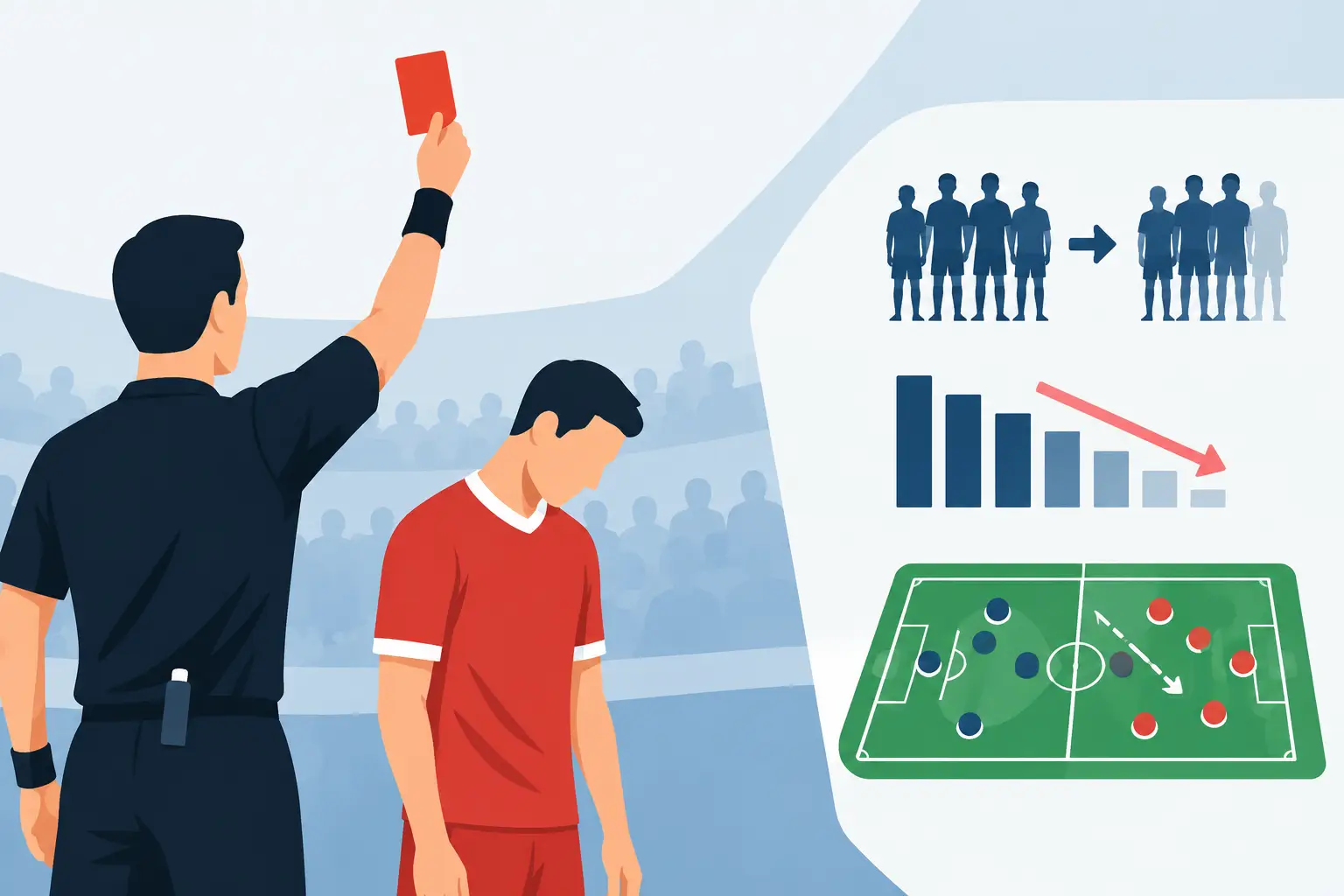
A red card does not just reduce a team to ten players. It rewrites the match. Red card impact analysis is the habit of watching the chain reaction that follows — a new defensive shape, a change in pressing intensity, altered territory, fresh space between the lines, and often a completely different tempo.
The dismissal is the headline. What happens over the next two, five and fifteen minutes is the story. This article is about how to read that, and — in one section near the end — what Sports Alert actually does and does not do with a red card.
Why a red card changes more than the scoreboard
Football is built on connections: who covers the wide channel, who screens the centre-backs, who presses the first pass, and who arrives late in the box. Remove one player and those connections have to be rebuilt under pressure, immediately, without a training session.
The immediate effect depends on who went off. A centre-back's dismissal can force a structural change, especially with no like-for-like defender on the pitch. A winger's is easier to absorb, though it may remove the outlet that was carrying transitions and pinning back the opposing full-back. A holding midfielder's can be the most disruptive of all, because it opens the space in front of the defence exactly as the opponent starts looking for it.
This is why possession after a dismissal misleads so often. A team down to ten may see less of the ball by choice and stay organised and dangerous on the counter. Another may keep the ball, lose every second ball, and concede territory steadily. The number looks similar. The matches are not.
Watching the reshape
The first question is simple: how does each side reorganise? A team protecting a lead may move from a 4-3-3 to a compact 4-4-1, sacrificing a forward to restore coverage. A side chasing the game might leave a lone striker high and accept risk in the wide areas. The opponent may push full-backs higher, move an extra midfielder between the lines, or switch play more quickly to stretch the reduced block.
Then look for the player who becomes overloaded. If a wide midfielder is suddenly responsible for defending the flank, supporting the full-back and offering a release pass, that side becomes a pressure point. If a centre-back is covering more space because the midfield screen has gone, through balls and late runs get more dangerous.
The first five minutes reveal intent
The opening moments after a dismissal are unusually informative. Teams often need a pause or a substitution to settle, but intent shows quickly. Does the team with ten drop its line immediately? Does it keep pressing high anyway? Does it still attack down the side it just weakened?
The opponent's response matters as much. Aggressive teams try to exploit the confusion with early vertical passes and quick restarts. More cautious ones settle into circulation first. Neither is automatically right — the score, the time remaining, the fatigue and the bench all shape it.
Why one extra player does not guarantee control
The familiar expectation is that eleven against ten means domination. Sometimes it does. Often it does not, and the reasons are worth knowing.
A team reduced to ten frequently becomes more compact, because it has fewer players pushing into attacking positions. That compactness closes central routes and invites low-value crosses. If the full-strength side then moves the ball slowly, forces passes into crowded zones, or sends too many bodies forward at once, it becomes vulnerable to exactly the counterattack it is trying to prevent.
There is an emotional effect too. A team that loses a player often responds with sharper concentration and a clear defensive job. The side with the advantage can grow impatient when early attacks come to nothing. So the useful question is never "does a red card mean more chances?" It is "where is the advantage actually developing, and is it repeatable?"
Game state decides the real impact
A red card at 0-0 in the 20th minute is not the same event as one shown to the leading team in the 89th. The number of players is identical; the conditions are not.
With plenty of time left, the eleven-player side has more chances to build overloads and wear the opponent down. With the clock nearly gone, the reduced team can sit deeper, slow restarts within the rules, and put everyone in the box. The scoreline changes the incentives too: a team trailing with ten has to press and leave space, while a team leading with ten can prioritise compactness and force the opposition to find a precise final pass.
Competition matters as well. In a knockout tie a side may protect the aggregate rather than the current match. In a rivalry, emotion raises the chance of another disruptive moment — a second yellow, a tactical foul, a loss of discipline.
Where Sports Alert fits
There is no red card impact analysis feature. It is worth being exact about what the card family does instead, because the difference is larger than it sounds: the live rules count cards, and a red card and a yellow card are added into the same total. Nothing in the alert path treats a dismissal as its own kind of event, weights it more heavily, or reacts to the reshape that follows.
So a red card can contribute to a card alert firing, in the same way any caution would. What reaches you is a signal that cards have been accumulating in this match, not a reading of what the dismissal did to the shape. Everything earlier in this article is something you are watching, not something the alert watched for you.
The families that can reach you are goal alerts, corner alerts, card signals, and the Pressure Signal. The Pressure Signal is observational — it reports activity that has already built up rather than forecasting what follows. The Pressure Signal compares how three counted events are moving for one side against the other over a rolling window — shots in the box, shots on target, and corners — and reports when one side is clearly ahead, within set minutes of the match and with a cooldown between messages. That description is specific to the Pressure Signal; the goal, corner and card families run on their own rules, and match predictions are a separate feature in the app rather than something delivered by these alerts.
Which channel carries an alert depends on your plan. Push notifications are included on every plan, Email is included on Pro and Max, and Telegram and SMS are Max-plan channels, each needing a one-off setup step first — Telegram has to be linked to your account, and SMS needs a verified phone number and carries a monthly message cap. Every channel has its own toggle in your notification preferences, and alerts are sent for matches you follow, so following the fixture is what brings it into scope. The Telegram channel guide walks through that setup.
What to watch until the final whistle
After the initial reshuffle, keep asking whether the match is stabilising or accelerating. If the ten-player team starts clearing its lines cleanly and winning midfield territory back, the numerical edge may be losing force. If attacks keep returning in waves, the defensive unit is probably spending its energy simply surviving.
Substitutions reset everything. A fresh runner restores an outlet for the short-handed side. An extra attacker creates a new overload but weakens the rest defence of the team with eleven. Late fatigue often makes the final fifteen minutes the most revealing stretch, particularly when the dismissed player's role demanded a lot of running.
The most useful habit is to treat the card as the start of a new match inside the match. Watch the shape, the pressure, the space and the response. The red card is one event; its impact keeps unfolding until the whistle, and reading it is still the part no counter does for you. How counted pressure becomes a notification is covered in football pressure shift alerts for live fans.
Follow The Matches That Turn
Create an account to follow live matches and explore the alerts available on your plan.
Create Free AccountThis content is for informational and entertainment purposes only. Sports Alert provides match analysis based on statistical models and threshold rules. It is not betting advice, not financial guidance, and carries no guarantee of future outcomes. For more information, please see our Disclaimer.