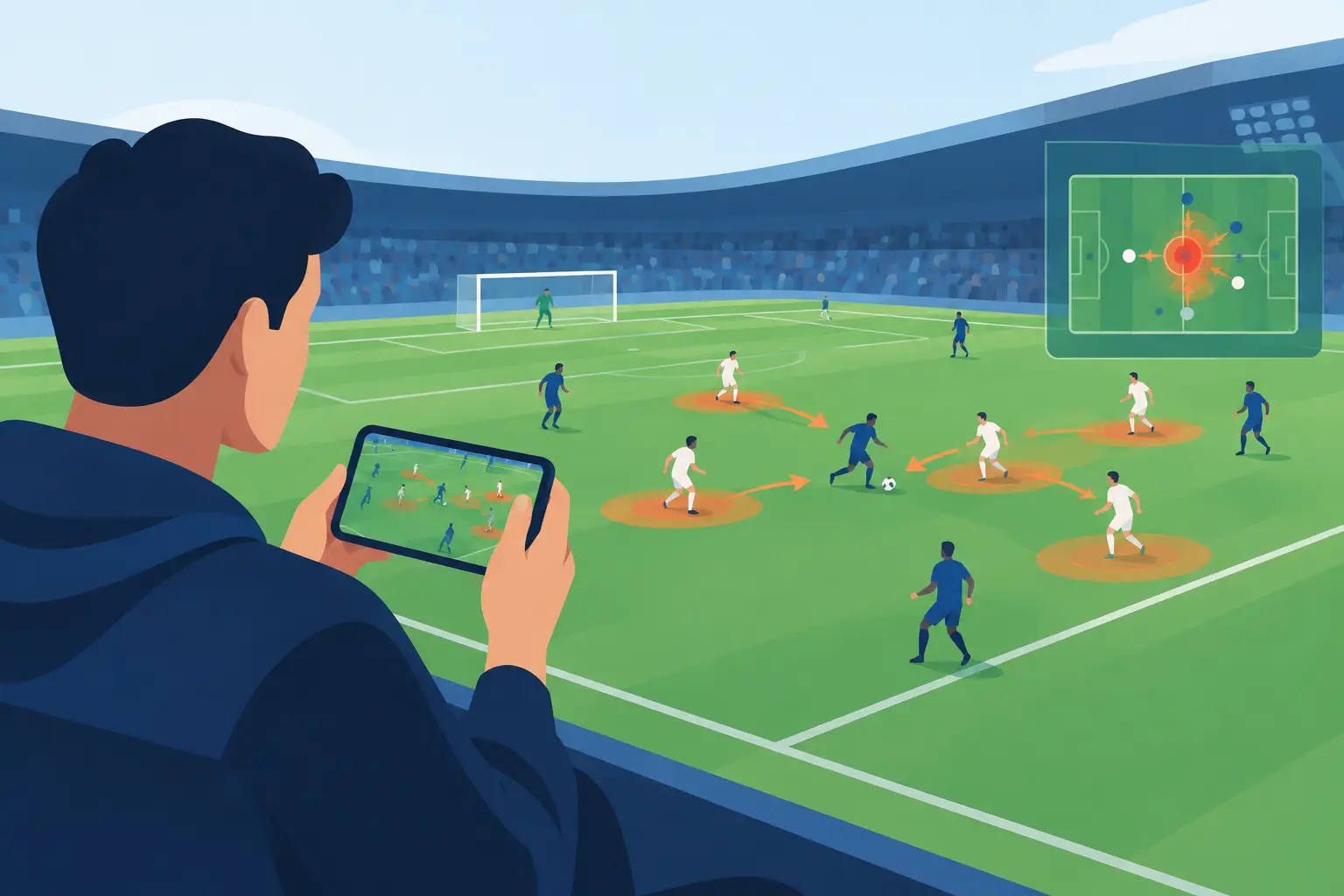
A match can look level on the scoreboard while one team is steadily taking control. The ball stays in the final third, clearances keep coming back, wide players keep winning corners, and the defending side cannot reset. Football pressure shift alerts are built for that moment: the developing story behind the score, delivered while it still matters to how you watch the match.
For fans following several fixtures, pressure is often what conventional live scores miss. It does not predict a guaranteed next event, and it is not betting advice. It gives you timely, data-backed context on which side is sustaining attacks and whether the run of play has changed.
What a pressure shift alert actually measures
Pressure, as fans use the word, is a broad idea: it takes in territory, recoveries high up the pitch, a change in passing tempo, a full-back being isolated, and the noise of a crowd sensing something. Those are real parts of watching football, and they are worth naming, because the alert is narrower than all of them.
The Pressure Signal reads three things: shots taken from inside the box, shots on target, and corners. It compares one team's totals against the other's, and against how the match had been running up to that point. It does not track where possession is recovered, it does not measure passing tempo, and it does not detect substitutions or tactical changes. Those remain a fan's read, not a product measurement, and this article keeps the two apart on purpose.
Narrow is not the same as crude. The signal waits until one side is clearly ahead on those counts rather than marginally so, and it judges the current spell against how that same match had been running rather than against football in general. It also avoids retelling the same story: one strong phase should produce an alert, not a run of near-identical ones.
Here is how that plays out. Imagine a match that has been quiet for 35 minutes, and then the home side wins three corners and puts together a run of shots from inside the area. A watching fan will also see the ball being won higher and clearances getting hurried — that is the fuller picture, and it is the reason the moment feels like a turn. What the signal registers is the narrower, countable part: corners and shots in the box climbing for one side while the other's stay flat. The score may still be 0-0, but on the counts the match is no longer neutral.
Why the score alone arrives too late
Goals are decisive, but they are also the final outcome of a sequence that may have been building for minutes. By the time a score app updates, the phase of play that created the chance has already happened.
Live commentary can capture the feeling of a match, especially when you are watching closely. It is less reliable when you are moving between games, commuting, working, or tracking a full slate. Commentary is also subjective. One broadcaster may call a spell of possession dominant, while another sees it as harmless circulation.
A pressure alert adds a consistent layer underneath that. It applies the same counts to every match it watches, which means the threshold does not drift with the tone of the broadcast. For a fan, that means fewer blind spots when a fixture suddenly becomes worth opening.
The difference between pressure and possession
Possession can be useful context, but it is not pressure by itself. A team can hold the ball safely across its back line for long periods without forcing a single meaningful defensive decision. Another can have less of the ball and still create the more dangerous sequences through quick transitions and direct running.
This is not a theoretical distinction in the product. Sports Alert records possession as one of the in-match statistics it tracks, and the Pressure Signal deliberately does not use it. Shots from inside the box, shots on target, and corners were chosen because they are closer to what a team is actually doing to an opponent's goal. A side can dominate the ball and never appear in that count.
The same caution applies to shot quality. Not every shot inside the box is a good chance, and the concept of chance quality — explained in more depth in what xG means in football — is a separate lens from the raw counts a pressure alert uses. Treating a pressure alert as a chance-quality model would be reading more into it than it claims.
A pressure shift can favour either team
The most obvious alert is an attacking surge from the side expected to control the ball. But the more revealing shifts often run the other way, and the signal is built to catch both: separate rules watch the home side and the away side. An underdog that starts winning second balls and reaching the final third after halftime will show up on the counts once those attacks become shots and corners.
A red card, an injury, a substitution, or a tactical adjustment can change a match quickly, and a watching fan will register that immediately. The alert will not: it has no knowledge of the substitution itself. What it can register is the consequence, if and when the change shows up as shots and corners moving for one side. That lag is worth understanding, because it tells you what the notification is and is not claiming.
How live signals become useful alerts
The challenge is not collecting match data. It is deciding what deserves your attention. Raw feeds create noise: every foul, throw-in, and minor statistical swing becomes another distraction. Serious fans do not need more notifications. They need the right one at the right time.
While a match is live, Sports Alert re-reads the match statistics it tracks and re-checks its alert rules against them on a repeating cycle. Only a small, chosen part of what is tracked feeds those rules. That restraint is the point: comparing the current phase with the match's earlier pattern is what separates a brief spell from a sustained change, and a rule that fired on everything would tell you nothing.
Ten minutes of pressure in an open, end-to-end game means something different from ten minutes of pressure in a slow tactical contest, which is why the comparison is always against that match rather than against a league-wide average. The goal is not to label every active spell a major shift. Those signals surface in the app as Radar, alongside goal, corner, and card alerts — the full set is described in custom football alert rules for live match fans.
When pressure alerts are most useful
Pressure context is especially valuable when you cannot give every match full attention. If you have a weekend slate with the Premier League, MLS, Liga MX, Serie A, and international fixtures all overlapping, a scoreline does not tell you which game has started to turn. A pressure update can.
It also improves the second-screen experience while you watch one primary match. You can stay focused on the game in front of you while receiving concise context from other fixtures. If an alert signals a sustained attacking phase elsewhere, you have a reason to check in before the key moment has passed.
For fan communities, the benefit is shared context. Rather than posting that a team "looks dangerous," you can point at something specific: one side has been taking the shots and winning the corners for a sustained spell. It makes the conversation sharper without making it overly technical.
Set alerts around how you follow football
The best notification strategy is personal. Some fans want every pressure update from their club. Others only want them in close matches or late-game situations. More alerts are not automatically better; if the set is too broad, the signal gets lost in the volume.
Start with the competitions you genuinely follow, then decide which moments would make you open an alert immediately. A fan watching from a desk may value a concise update during the second half. A supporter following a club abroad may want more coverage across the match.
Where the alert reaches you depends on your plan and on a little setup. Push notifications are included on every plan, email on Pro and Max, and Telegram and SMS on Max. Availability is not the same as delivery: Telegram has to be linked to your account, SMS needs a verified phone number, each channel has its own toggle in your notification preferences, and SMS carries a monthly cap. Alerts are also sent for the matches you follow, so following a fixture is what puts it on your radar in the first place. Custom alert rules are listed as a Max-plan feature; there is no screen in the app today for building your own rule or setting your own threshold.
Read the alert as context, not certainty
A pressure shift is a live condition, not a promise. Teams can take the shots and win the corners and still fail to score. A goalkeeper can make a key save, a defender can block a clear chance, or the leading side can absorb the phase and break forward decisively. Football remains unpredictable because the events that decide matches are rare and high consequence.
That uncertainty is what makes this kind of context valuable when it is used responsibly. It helps you understand the match before the scoreboard fully explains it. It can show why a 1-0 lead feels fragile, or why a 0-0 draw has suddenly become intense.
The next time a scoreline says little, watch for the sequence underneath it. When the shots and the corners start pointing the same way, the match is telling you something. The right alert simply helps you hear it in time.
See the Match Change Before the Score Does
Create an account to follow live matches and explore the alerts available on your plan.
Create Free AccountThis content is for informational and entertainment purposes only. Sports Alert provides match analysis based on statistical models and threshold rules. It is not betting advice, not financial guidance, and carries no guarantee of future outcomes. For more information, please see our Disclaimer.