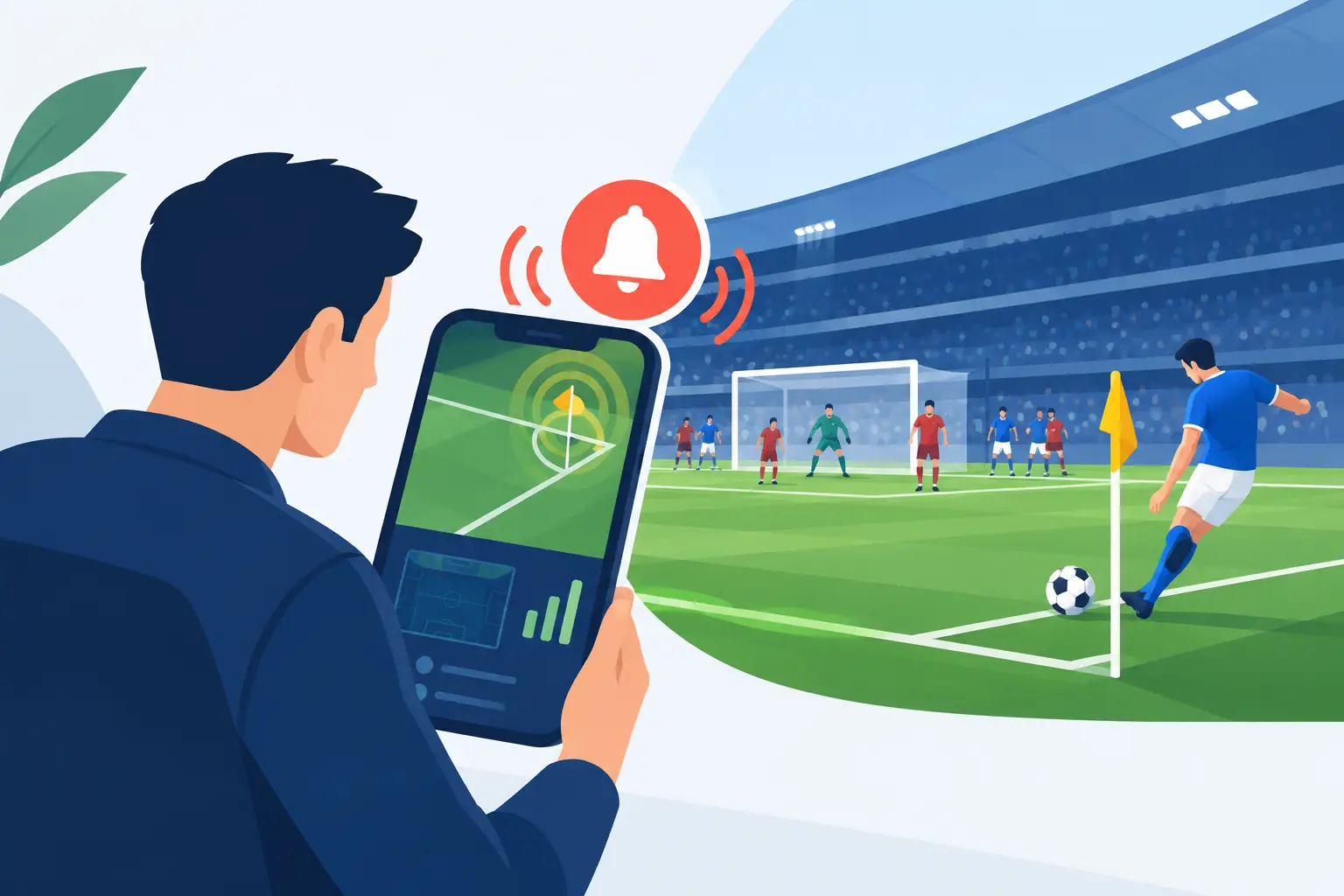
A corner is rarely just a corner. In the 72nd minute, three in five minutes can tell you more about a match than any possession figure. One side may be pinning the other inside its own box, forcing blocked shots, rushed clearances and mistakes that never reach a basic score feed. Live corner alerts are one way to turn that into something you notice in time.
The challenge for anyone following more than one fixture is not finding data. It is knowing which change matters right now. This article is about reading a corner surge properly — and, in one section, exactly what the Sports Alert corner alert does and does not take into account.
What a corner surge actually tells you
Corners are among football's most visible pressure events. They stop play, pull defenders into the box, and usually arrive at the end of a chain: a cross deflected behind, a shot blocked, a save, a last-ditch tackle. But their meaning changes from match to match.
One corner after an isolated counterattack is a different thing from four won during a sustained spell of high pressure. A team can win several because it keeps crossing from poor positions, while another creates two and turns both into real chances. The signal is not that a corner happened; it is whether the corner belongs to a pattern.
So the questions worth asking are the surrounding ones. Are shots rising with the corners? Is the defending side escaping its own half at all? Are attacks arriving repeatedly through the same overloaded channel? Is the goalkeeper being made to work, or comfortably claiming everything? A corner count answers none of these, which is precisely why it is so often misread.
Not every corner surge means the same thing
Corner volume has real limits as evidence, and knowing them is most of the skill.
A team can dominate corners and create nothing. Some defences deliberately concede crosses from low-value areas, confident of clearing them, and a rising corner count is the price they happily pay. A compact low block can hand the attacking side a long series of corners while central space stays completely shut.
Game management explains a lot of them too. A trailing team forces more corners late precisely because the leading side has retreated to protect its box. That pressure is genuine, but part of it is the scoreline talking rather than a tactical breakthrough. Repeated corners against a defence already showing disorganisation — losing second balls, clearing straight to an opponent, unable to get out — carry considerably more weight than the same number against a settled one.
And a corner is a poor scoring chance most of the time. A surge raises the chance of a goal; it does not promise one. A set-piece sequence can repeat six times without a single clean contact.
What the corner alert actually watches
Here is the product half, and it is narrower than the discussion above. The corner alert watches the match total of corners — both sides added together, not one team's surge — and fires once that running total passes a set threshold. It is constrained to a window of the match and carries a cooldown so a busy spell does not produce a stream of messages.
What it does not do is weigh any of the context in the previous section. It does not know which side won them, whether the defending team is disorganised, whether the scoreline is driving the pressure, or where on the pitch the attacks came from. It is a threshold on a count, and reading it as anything more would be reading in something that is not there.
That is useful in a specific way: it tells you a match has become busy enough to be worth a look, which is exactly what you want when you are following several at once and cannot watch them all. The interpretation — is this a low block absorbing harmless crosses, or a defence starting to crack? — stays yours.
The other families run on their own rules: goal alerts, card signals, and the Pressure Signal. The Pressure Signal is observational, reporting activity that has already built up rather than forecasting what follows. The Pressure Signal compares how three counted events are moving for one side against the other over a rolling window — shots in the box, shots on target, and corners — and reports when one side is clearly ahead, within set minutes of the match and with a cooldown between messages. That description is specific to the Pressure Signal, and match predictions are a separate feature in the app rather than something delivered by these alerts. So corners appear in two different places, measured two different ways, and it is worth knowing which one produced the message you just received.
Building a setup around how you watch
Fans do not all follow football the same way. One person watches a full Saturday slate; another tracks a favourite club from a phone between meetings. The right setup depends on your attention, not the fixture list.
Start with selectivity. Turn on everything and even good notifications become background noise. Corner alerts work best paired with a clear purpose: find matches where something is building, or keep half an eye on concurrent fixtures without staring at a score feed.
Then pick the channel. Push notifications are included on every plan, Email is included on Pro and Max, and Telegram and SMS are Max-plan channels, each needing a one-off setup step first — Telegram has to be linked to your account, and SMS needs a verified phone number and carries a monthly message cap. Every channel has its own toggle in your notification preferences, and alerts are sent for matches you follow, so following the fixture is what brings it into scope at all.
One limit worth stating plainly: custom alert rules are listed as a Max-plan feature, but the app does not currently give you a screen where you build a rule or set your own numeric threshold. The levers you actually control are which fixtures you follow, which families stay on, and which channels carry them.
A better second screen
Imagine following two scoreless matches at once. The first has steady possession and no penetration. The second has shifted: consecutive corners, the ball being won back high, pressure climbing. A basic app makes both look equally quiet.
That is the gap a corner alert fills — not by explaining the match, but by telling you which one to open. When the next notification arrives, the useful question is not how many corners a team has won. It is where they came from, whether the defending side is clearing its lines or scrambling, and what the sequence says about the ten minutes ahead. How counted pressure becomes a notification is covered in football pressure shift alerts for live fans, and the wider set of families in custom football alert rules.
See Which Match Is Turning
Create an account to follow live matches and explore the alerts available on your plan.
Create Free AccountThis content is for informational and entertainment purposes only. Sports Alert provides match analysis based on statistical models and threshold rules. It is not betting advice, not financial guidance, and carries no guarantee of future outcomes. For more information, please see our Disclaimer.