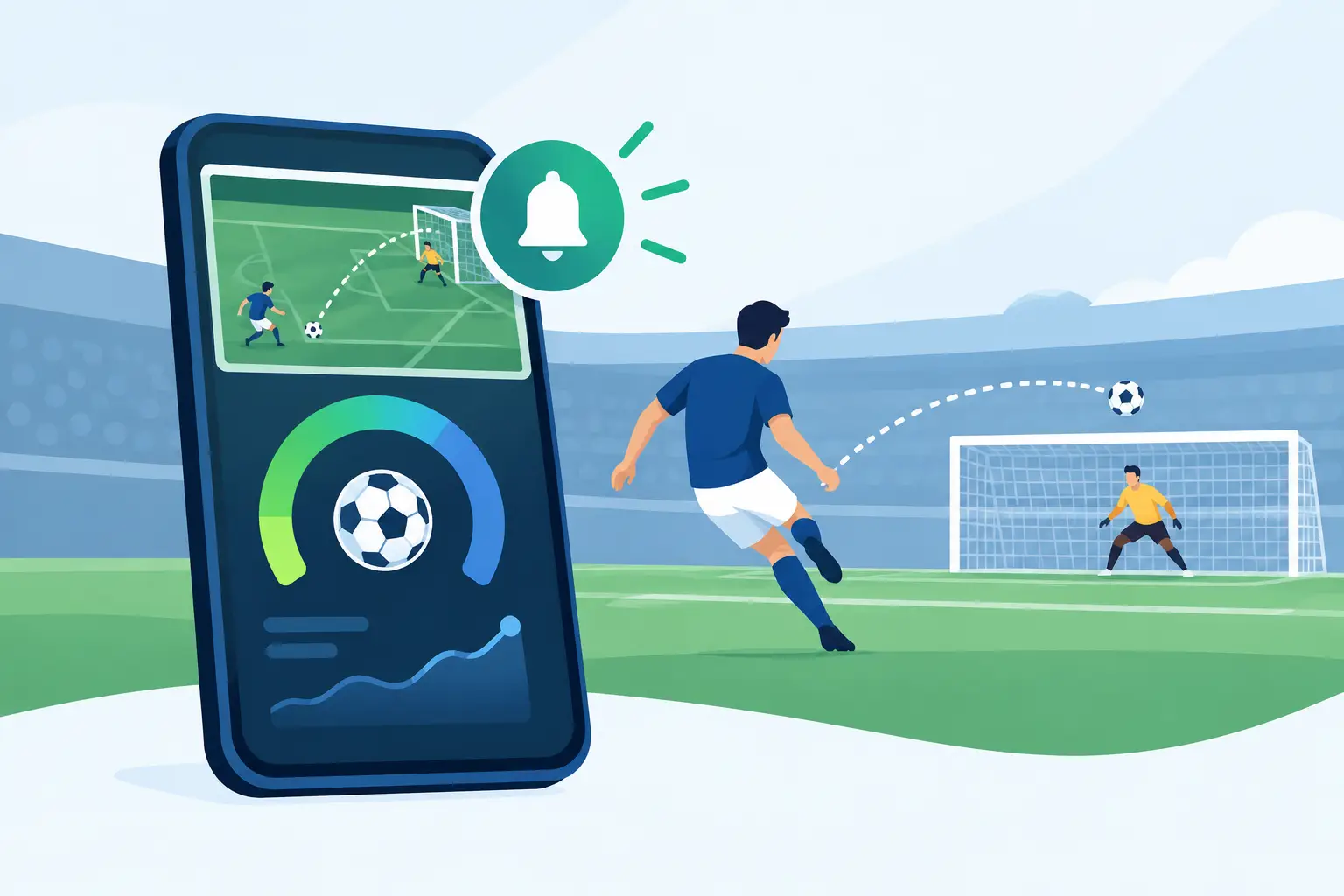
A scoreline can look settled right up until it is not. One side leads 1-0, but the entries into the box keep coming, the corners are stacking up, and the defending team cannot clear properly. Something has changed that the score has not caught up with.
If you have searched for goal scoring probability alerts, that gap is what you are trying to close. The honest answer about Sports Alert comes in two parts. A live goal alert is a threshold rule, not a probability model: it fires because counts crossed a line. After it fires, some goal-alert cards in the app show a model lean with a percentage — and that number is not the chance that a goal is coming. Both parts are explained below.
What a live goal alert actually counts
A goal alert watches a small set of countable match events and fires when they cross a line the rule sets. Which events depends on the rule: shots on target feature in most goal rules, and others lean on shots from inside the box, blocked shots, dangerous attacks — an attacking-pressure count the match data provider records — and the provider’s own tally of big chances.
Some rules also check the state of the match before they fire: that the score is level or close, or that the other team is not producing the same pressure. Some combine several conditions in one of their routes to firing, such as total shots, corners and possession together. So this one family comes down to counts, conditions on the match state, a threshold, a time window, and a cooldown so the same story is not told twice.
The decision to fire involves no probability. It does not wait for a model to say a goal is likely, and it does not weigh who is taking the shots. Where a rule counts big chances, it is counting the data provider’s tag, not grading the chances itself. A rule that fires on those counts is telling you the counts moved, not that a goal is due.
The checking itself is unglamorous. While a match is running, Sports Alert re-reads the match statistics it tracks for both teams and re-checks its alert rules against them on a repeating cycle, so a rule can fire mid-match rather than after it. No rate is published here, because none is fixed: Sports Alert sets the interval on its side and can change it, so a published figure would be wrong somewhere.
The percentage you may see on a goal alert
Open some goal alerts in the app and you will see a short line labelled Model leans, naming one team with a percentage — say, 64%. It can appear on some of the general goal alerts, the ones that do not name a team — not on every one — and only when the number is high enough to be worth showing. In the app, those alerts are labelled as a goal prediction (Goal prediction, or First-half goal prediction for the first-half alert), because what they anticipate is a goal.
That percentage is not the chance that a goal is coming. It is one of two things, and the card carries a short note saying which — and both only count situations in which another goal is scored at all. It is either the favoured team’s share of the goals the model expects, or, looking only at comparable past alerts that were followed by a goal, how often the favoured team was the one to score it. It is worked out after the alert has fired, it does not decide whether the alert fires, and the alert is not judged on it: a general goal alert is scored on whether a goal followed, not on which team scored it.
On a match’s page, an alert can also carry a line labelled Historical accuracy with a percentage of its own. That one is a record, not a model: over the last 30 days, of the alerts of the same type and the same place in a match’s sequence — first alert, second alert, and so on — that have been scored, how many were correct. The app itself notes that it is not a probability for the current alert. It tells you how this kind of alert has done, not what this match will do.
So read the lean as context, not as a forecast. A card that says one team leads the lean is telling you which side the model’s scoring expectation favours if the match produces another goal — not that a goal is likely, and not when.
Where pre-match probabilities live
None of that means Sports Alert avoids probability. It does not: the app has a Predictions surface of its own, where match predictions are produced and shown. Probabilities are a real part of the product.
Those predictions are pre-match. For the day’s upcoming fixtures they cover the match result, plus market tiles for over 2.5 goals, both teams to score, a clean sheet for each side and each side to score — and they are not a live reading of a match that has already kicked off. In the app, the Predictions tab currently appears on the Pro and Max plans.
The alert families that reach your phone are goal alerts, corner alerts, card signals and the Pressure Signal, and those rules are set by Sports Alert rather than assembled by each subscriber. None of them fires because a probability crossed a line: a probability-driven alert is not among them today. The model lean is context attached after an alert fires, not its trigger.
So the pieces sit side by side: threshold rules do the interrupting, the model lean adds context to some goal alerts once they have fired, and pre-match predictions are something you go and look at before kick-off.
Pressure is more than a shot count
Shots matter, but their timing and context matter too. Three speculative efforts from distance do not carry the same weight as a spell of close-range chances, blocked attempts and corners. Fans read that difference easily; a single shot count does not.
That is the gap the Pressure Signal is built for, and it is worth knowing precisely what it compares. The Pressure Signal reads shots taken from inside the box, shots on target and corners, for one team measured against the other and against how that same match had been running up to then. It waits until one side is clearly ahead on those counts rather than marginally so.
It is still counting, not modelling. It does not track where possession is recovered, it does not measure passing tempo, and it does not detect substitutions, formations or tactical changes. Sports Alert records possession as one of the in-match statistics it tracks; the Pressure Signal deliberately does not use it, though possession does appear in one route into some goal rules. There is no shot-quality model behind the Pressure Signal either — the concept of chance quality, explained in what a tactical read gives you, is a separate lens from the raw counts an alert uses.
The football a threshold cannot see
Everything that makes a scoring phase interesting to watch sits outside the count. A team chasing an equaliser pushes its full-backs higher, the opponent drops into a low block, clearances keep coming back. The pitch is tilting and defensive relief has run out.
Game state matters too. A late spell of pressure in a level knockout tie carries a different weight from the same spell in a league game one side is winning comfortably. Fatigue, substitutions, scoreline incentives and a change of shape all affect how open a match becomes.
A few rules check the score before they fire, but none reads fatigue, substitutions, incentives or a change of shape. That is football you read, and it is the part that gives a notification its meaning. The alert supplies a fast, countable signal; your knowledge of the game supplies everything else.
Using goal alerts well
Treat an alert as a prompt to look, not a verdict. Check the score, the match minute and what has just happened. If you can watch, use it to work out why the match has become active. If you cannot, use it to stay connected to fixtures a plain score notification would leave flat.
On a busy Saturday it also helps you prioritise. Rather than cycling through ten matches looking for the live one, you let the counts tell you which fixture has separated itself. The levers you genuinely control are which fixtures you follow, which alert families stay switched on, and which channels carry them. Following a fixture is also what brings it into scope at all: alerts are sent for matches you follow.
There is no screen where you build a rule or set your own numeric threshold; custom alert rules are listed as a Max-plan feature and are arranged with the Sports Alert team. And there is no separate alert for an unusual or anomalous scoring phase — what can surface a late surge is a late Pressure Signal, because the underlying counts moved.
Channels have their own lines, and a plan makes a channel available without switching it on for you. Push notifications are included on every plan. Email is included on Pro and Max. Telegram and SMS are Max-plan channels, and each needs a one-off setup step first: Telegram has to be linked to your account, and SMS needs a verified phone number. Every channel also has its own toggle in your notification preferences, and SMS carries a monthly message cap.
What these alerts cannot tell you
A threshold is not a forecast, and a responsible alert should say so plainly. An alert does not know the minute of a goal, the scorer, or whether a promising attack survives a refereeing decision. It reports that a count crossed a line on the data available. It cannot remove football’s unpredictability.
There are real trade-offs in where a line sits. A lower threshold surfaces more developing spells and also more notifications that lead nowhere. A higher one is more selective and misses early signs of a match turning. Sports Alert sets those lines rather than leaving them to you, which is a trade in itself: less control, fewer decisions to get wrong.
These updates are for information and entertainment, not betting advice, financial guidance or a guarantee about any match outcome. Their purpose is to make live football easier to follow.
Make the next match easier to read
Football’s biggest moments rarely arrive from nowhere, and the countable part of the build-up is often visible before the score moves. That is the part an alert can hand you quickly.
Just hold it for what it is: a count that crossed a line, with, on some goal alerts, a model’s lean on which side the next goal favours — not the chance of a goal, and not a promise. Keep one eye on the score, let the alert tell you which match is worth opening, and let your own reading of the game do the rest.
See Which Match Is Worth Opening
Create an account to follow live matches and explore the alerts available on your plan.
Create Free AccountThis content is for informational and entertainment purposes only. Sports Alert provides match analysis based on statistical models and threshold rules. It is not betting advice, not financial guidance, and carries no guarantee of future outcomes. For more information, please see our Disclaimer.