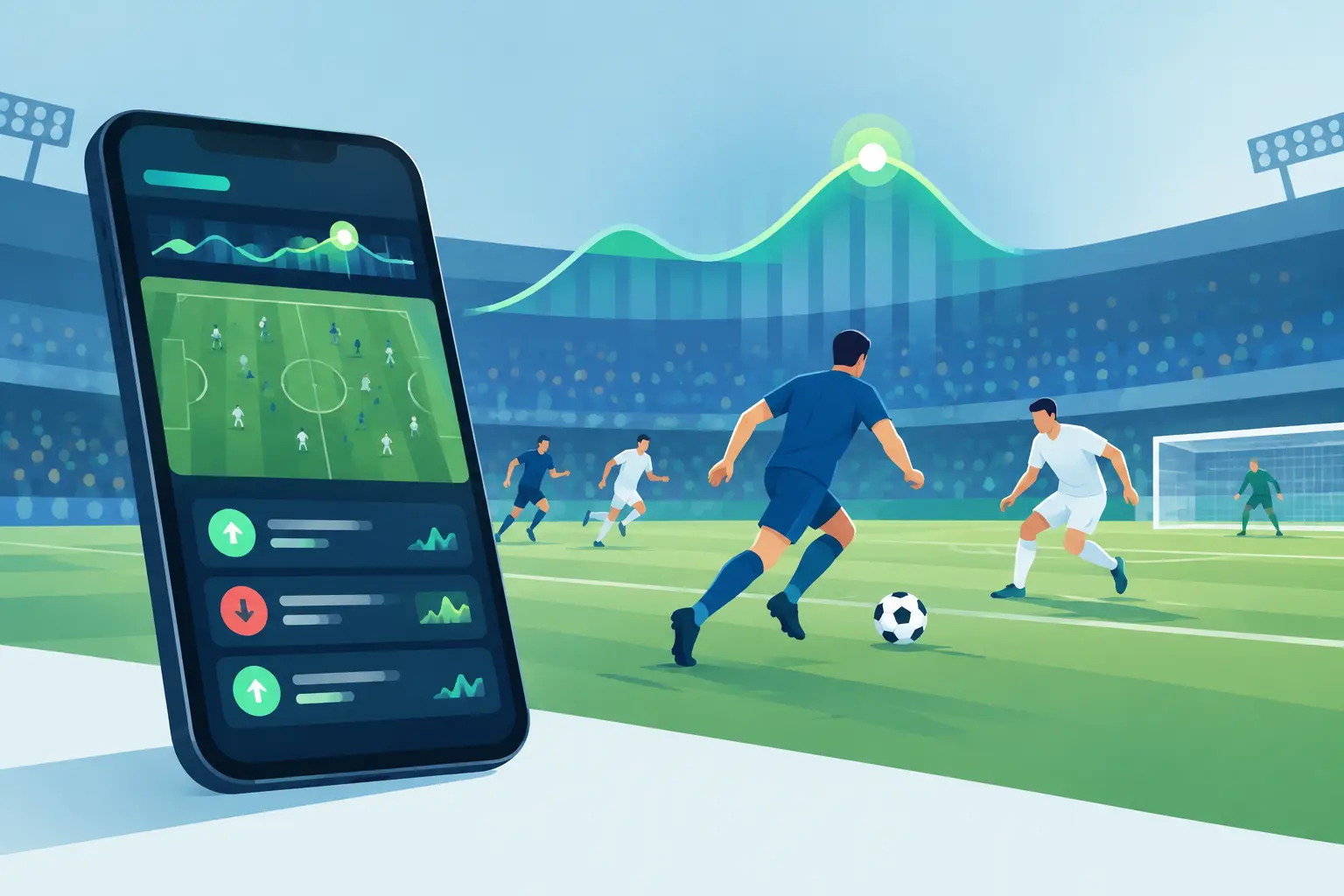
A match can look level on the scoreboard while one team is taking control everywhere else. The ball is spending more time in the final third. Corners are stacking up. A fullback is being isolated. The home crowd has found its voice. Live football momentum alerts are built for that gap between the score and what the match is actually telling you.
For fans following more than one fixture, the problem is not a lack of information. It is too much of the wrong kind. A standard live score tells you a goal happened. Basic stats may show possession and shots. Neither always explains whether a tactical shift is building pressure, whether a team is recovering control, or whether a quiet match has suddenly changed character.
That is where real-time match intelligence earns its place on your second screen. It turns a flood of live signals into a clear update you can understand in seconds.
Momentum is more than possession
Football momentum is not one metric, and it should never be treated as one. A team can dominate possession with harmless passes near midfield while the opponent creates repeated overloads, wins dangerous set pieces, and forces last-ditch defending. Momentum develops through combinations of events: sustained territory, attacks entering the penalty area, shot quality, corners, transition frequency, and the changes that follow a card or a substitution. Context matters too, because a red card at 1-1 means something different from a red card when a side is already protecting a two-goal lead. How those combinations are read while the match is moving is explained in AI football match analysis that sees the shift. This article is about what happens next, when a reading becomes a notification.
How live football momentum alerts work
The strongest alert systems monitor the match continuously rather than waiting for traditional headline events. At Sports Alert, live match data from 30-plus football leagues refreshes every few seconds, and dozens of in-match statistics for both teams are checked against threshold rules as they change. The purpose is not to bury fans in numbers. It is to make the numbers readable at the moment they become meaningful.
Think of it as a live radar, which is exactly what Sports Alert calls it. Instead of refreshing a score app and interpreting every stat yourself, you receive a Pressure Signal when several indicators point in the same direction for one side. Momentum is the live-match concept behind that signal. It is surfaced through pressure and momentum signals, shown as Radar in the app, rather than as a separate alert family of its own.
How a Pressure Signal is built
One corner rarely defines a game. Neither does one shot, one turnover, or a brief spell of possession. A Pressure Signal is built from clusters, pace, and deviation from the match's earlier pattern. Momentum is the match state being read; the Pressure Signal, shown as Radar in the app, is how the product surfaces it. The rules watch for a sustained run of attacking actions inside a defined window, compare it with the game so far, and hold the signal back until the pattern persists past a threshold.
For example, a game may be balanced for 60 minutes before one side begins winning the ball higher, creating faster attacks, and pinning the opponent deep. The score may still be 0-0, but the conditions are no longer balanced. A Pressure Signal can flag that developing story before a goal, card, or major chance makes it obvious to everyone.
That does not mean every pressure phase ends with a decisive moment. Football remains unpredictable, and a disciplined defense can absorb a surge. Match intelligence is context, not certainty. Its value is helping you notice what is changing and decide where to focus your attention.
Delivered where you follow the game
Speed only matters if the update reaches you in a useful place. Sports Alert supports push notifications, with email available on Pro and Max plans and Telegram or SMS available on Max. Push works when you are moving between fixtures, email fits a broader match-monitoring routine, and Telegram or SMS suit direct, immediate updates.
The best channel depends on how you follow football. If you are watching one marquee match, a few high-value alerts may be enough. If you are tracking a Saturday slate across leagues, timely notifications can help you spot the fixture that has become must-watch. The aim is not to interrupt every moment of your day. It is to surface the moments that deserve attention.
What to look for in a momentum alert
Not all alerts are equally valuable. An update should provide enough explanation to be useful as a viewing cue, not just a vague claim that a team is "on top." The strongest messages combine immediacy with a reason.
A useful alert may point to sustained attacking pressure, an increase in dangerous entries, a sequence of set pieces, or a clear swing following a tactical change. It should tell you what is happening now while leaving room for the reality that the next phase of play can still change everything.
Look for four qualities:
- Timing: The signal arrives while the pattern is developing, not after the match commentary has already caught up.
- Context: The alert identifies the nature of the shift, such as pressure, transitions, territorial control, or a post-substitution change.
- Restraint: It avoids turning every routine event into an urgent notification.
- Control: You can choose which alert types and channels you receive, so the setup fits your football routine.
That last point becomes especially important for serious followers. One person wants every goal, corner and card alert across a busy weekend. Another only wants a Pressure Signal when a scoreless game becomes tactically alive. Custom alert rules are available on the Max plan and are configured with the Sports Alert team, which keeps the experience relevant and reduces notification fatigue.
A better second-screen experience
Live football is increasingly a multi-screen experience. You might have a match on television, scores on your phone, a group chat running, and several international fixtures competing for attention. In that setting, momentum alerts are not meant to replace watching the game. They help you watch smarter.
They can also add context when you cannot watch. If you are checking a match between meetings or commuting during the second half, a scoreline alone offers a thin version of the story. A well-timed update about sustained pressure, a defensive collapse, or a shift after a card gives the score a shape.
For fan communities, the benefit is shared awareness. Rather than reacting only after a goal notification lands, supporters can discuss the pattern forming on the pitch. Was the warning there? Did the manager's adjustment settle the game? Has the underdog found a way out of pressure? These are the details that make live football feel alive beyond the final result.
Where the data needs humility
Even a system that processes dozens of statistics and the signals derived from them cannot see every human variable, from a player carrying a knock to instructions changed between phases. The limits of live analysis are covered in more depth in the analysis article linked above. Here, the distinction that matters most is between pressure and threat.
Some teams are excellent at generating activity but less effective at converting it into clean chances. Others can look passive for long stretches and still create danger through one elite transition. That is why alerts should complement football judgment, not substitute for it.
Responsible live intelligence makes that boundary clear. It is designed for information and entertainment, helping fans interpret matches with more depth. It is not betting advice, financial guidance, or a promise about what will happen next.
Build alerts around how you watch
The most useful setup starts with your own habits. Decide which alert types deserve an interruption and which channels should carry them. You may prioritize Pressure Signals in close matches, goal alerts after halftime, card-driven changes, or corner alerts in fixtures you cannot watch live.
If your schedule is packed, fewer, higher-threshold notifications are usually better than constant noise. If you run a group chat around weekend football, broader coverage may make more sense. There is no universal setting because there is no universal way to follow the sport.
The real advantage of live football momentum alerts is simple: they give you a faster read on the match beneath the score. Keep the alerts relevant, treat them as intelligent prompts rather than predictions, and let the next notification point you toward the part of the football day that is starting to matter.
Get Alerts That Read the Match
Create an account to follow live matches and explore the alerts available on your plan.
Create Free AccountThis content is for informational and entertainment purposes only. Sports Alert provides match analysis based on statistical models and threshold rules. It is not betting advice, not financial guidance, and carries no guarantee of future outcomes. For more information, please see our Disclaimer.