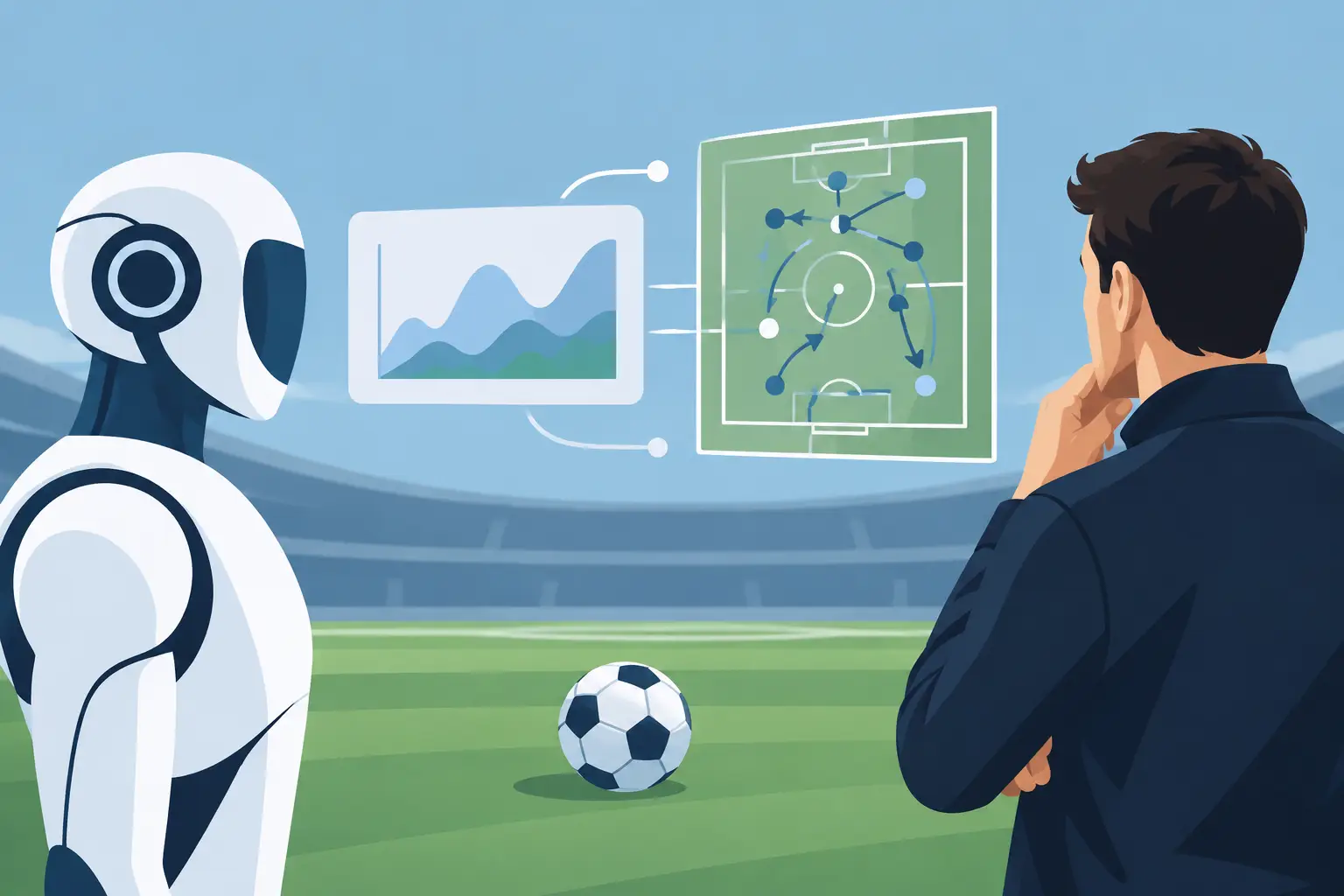
A team has 14 shots, five corners, and long stretches in the opposition half. The scoreboard is still 0-0. Can AI predict tactics from that picture, or is it simply measuring a match that already happened? For football fans following several games, the useful answer is more measured: AI can identify patterns that may be consistent with a tactical approach, but statistics alone do not fully explain the decisions behind them.
This article discusses AI in general terms; it is not a description of how Sports Alert works.
What It Means to Predict Tactics
Tactics are not just a team’s formation on the lineup graphic. They are the choices a side makes to create, protect, or change space: pressing high or waiting deeper, moving play wide, attacking quickly after winning the ball, or slowing the game down when ahead.
Predicting tactics can mean two different things. The first is recognizing a pattern already visible in the match. A side may be producing repeated attacks from wide areas, for example, and accumulating corners. The second is forecasting what a team will do next. That is much harder, because coaches and players can change their approach after a substitution, a yellow card, a goal, or a brief conversation at the touchline.
AI models work best when the question is narrow. They may estimate the likelihood of an event or classify a recurring pattern in historical data. They are less convincing when asked to explain intent with certainty. The same run of shots can come from a deliberate attacking plan, a defensive error, game state, fatigue, or a few loose clearances.
The Data Behind AI Tactical Predictions
Any prediction is limited by what the model can observe. Event data records actions such as shots, corners, cards, and other match incidents. It is valuable because it turns a football match into a sequence that can be compared across many games. A model can learn that certain combinations of incidents have often appeared before later events.
But event data is an indirect view of tactics. A count of dangerous attacks, for instance, reflects an assessment recorded by a match-data provider. It may suggest sustained attacking activity, but it does not show exactly where every player stood, who was instructed to press, or why a move broke down.
More detailed forms of data can offer a richer picture in general football analysis. Player and ball location data can help analysts study spacing, defensive lines, and movement patterns. Video can add context about body shape, passing lanes, and off-ball runs. Even then, a model is interpreting evidence rather than reading a manager’s instructions.
That distinction matters. A useful system should separate what it observed from what it inferred. “This team has taken several shots from inside the box” is an observation. “This team will switch to a two-striker system” is a much stronger claim that requires information the statistic may not contain.
Why Game State Changes the Meaning of Every Number
A match is not a laboratory. The score, clock, home crowd, fixture schedule, and personnel all affect how statistics should be read.
Consider a team with few shots but a lead to defend. Its lower attacking output might not signal a failing attack. It may reflect a deliberate choice to reduce risk and protect central areas. On the other hand, a team with 70 percent possession may look dominant while creating little danger if most passes are far from goal.
Cards change the picture as well. A yellow card can alter how aggressively a defender challenges. A red card changes the numerical balance and often reshapes the entire match. Corners can indicate territorial pressure, but they can also result from a single sequence of blocked crosses. No individual number settles the tactical question.
This is why good analysis looks for sequences and combinations rather than single numbers. The score, the clock, and the pace of play all change what a shot total or a possession figure means.
Can AI Predict Tactics Before a Team Changes Them?
Sometimes, AI can detect conditions that make a tactical adjustment plausible. If a team is repeatedly blocked in central areas, an analyst may reasonably watch for a greater focus on wide delivery. If attacks are being stopped high up the field, a model may identify a pattern associated with aggressive pressure.
Plausible is not the same as certain. Football contains deliberate deception. A manager may invite pressure before counterattacking. A team may attack one flank repeatedly to open space on the other. A player’s individual quality can also make a pattern look tactical when it is simply the result of one excellent performance.
The strongest use of AI, then, is not as a tactical oracle. It is as a prompt to look more closely. A fan can then watch the match, check the score and context, and decide what the evidence means.
Prediction Models Need a Clear Target
“Predict tactics” is too broad for a model unless the target is defined. A system might be trained to estimate, for example, whether a team will win the match. That is an event-focused question. It differs from predicting a coach’s formation or next instruction.
Clear targets also make evaluation possible. A model can be tested against later match events and judged by how often its estimates were useful or wrong. Tactical claims are more difficult to test because the true intent behind a decision is often unknown outside the dressing room.
For fans, this suggests a practical rule: treat predictions as prompts, not verdicts.
Following Matches on Sports Alert
At Sports Alert, people can Track a match and receive alerts when match statistics meet a rule. Goal, corner, and card alert rules watch measures that include shots on target, shots from inside the box, blocked shots, dangerous attacks, big chances, corners, and yellow and red cards counted together.
A general goal alert is labeled a “goal prediction.” It anticipates another goal by either team before full time, and it can be wrong.
For matches a person has chosen to Track, goal, corner, and card alerts can arrive as push notifications, with a separate preference switch for each type. A goal alert can also be triggered by a confirmed penalty award.
The Limits Are Part of the Value
It can sound less exciting to say that AI has limits, but that honesty makes it more useful. Models depend on the quality and consistency of the data they receive. They can be affected by unusual matches, small samples, changing squads, and events that statistics do not capture well.
They also operate on past patterns. Football changes when a new coach arrives, a key player is unavailable, or a team changes its approach during a season. A model can adapt only through the information and training process available to it. It cannot remove uncertainty from a sport built on imperfect decisions and unexpected moments.
The best question is not whether AI can replace a football watcher’s judgment. It is whether it can make that judgment more informed. When a match pattern catches your eye, use the numbers as a starting point, then let the game supply the context.
This content is for informational and entertainment purposes only. Sports Alert provides match information and alerts. It is not betting advice, not financial guidance, and carries no guarantee of future outcomes. For more information, please see our Disclaimer.